
Sermon Summary
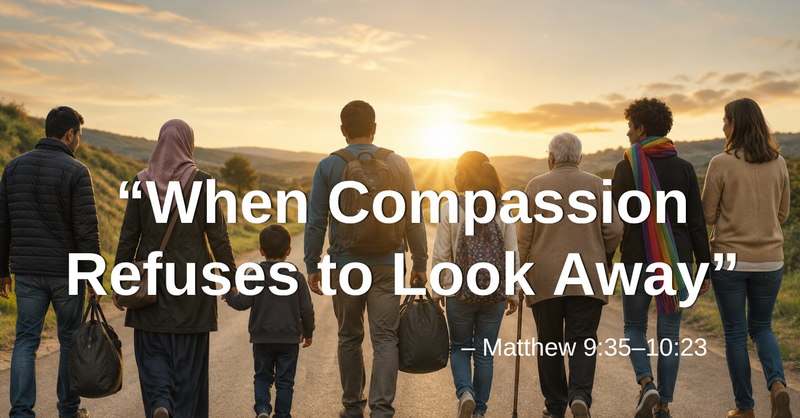
Compassion stands at the center of Jesus' ministry. As he travels through towns and villages proclaiming good news and healing the suffering, Jesus looks upon the crowds and sees people who are harassed, helpless, and abandoned. Rather than turning away, he allows their pain to move him toward action. This moment serves as a model of Christian discipleship in every generation.
World Refugee Sunday provides a contemporary lens for understanding this Gospel call. Refugees are often reduced to statistics, political arguments, or cultural fears, yet Jesus challenges believers to see beyond labels and recognize sacred human stories. The sermon contrasts assimilation with genuine hospitality, arguing that authentic welcome does not require people to erase their identity but creates opportunities for mutual learning, growth, and transformation. Biblical narratives repeatedly remind God's people that they, too, have known displacement, migration, and life as strangers.
The sermon also confronts the tendency among some religious communities to dismiss concerns for justice, inclusion, and human dignity as "social justice" rather than recognizing them as central expressions of the Gospel itself. Jesus' ministry consistently joined spiritual transformation with healing, restoration, and advocacy for those on the margins. As Pride Month begins, the message briefly acknowledges that many LGBTQ+ people experience exclusion and rejection, reinforcing the broader biblical theme that God's grace continually expands the circle of belonging.
Welcoming new members becomes a living embodiment of this vision. Membership is presented not as institutional growth but as a mutual covenant, where both congregation and newcomer are transformed through shared life and ministry. Ultimately, prayer is reimagined as more than asking God to meet personal needs; prayer becomes a spiritual practice that reshapes hearts, deepens compassion, and equips disciples to participate in God's work of healing and justice. The sermon concludes by challenging the church to become a community that sees people rather than problems and whose compassion refuses to look away.
Key Takeaways
- Jesus responds to suffering with active compassion: Compassion in the Gospel is not passive sympathy but a force that moves people toward healing, justice, and service.
- Refugees are people, not political issues: The church is called to see the sacred stories and human dignity behind labels, statistics, and cultural fears.
- Hospitality is different from assimilation: Genuine welcome creates space for mutual learning and relationship rather than demanding that newcomers abandon their culture, traditions, or identity.
- Justice is part of the Gospel: Caring for the hungry, welcoming strangers, defending human dignity, and challenging oppression are not distractions from faith but expressions of faithful discipleship.
- Prayer transforms those who pray: Prayer is not only about asking God for help but about opening ourselves to God's compassion and becoming more responsive to the needs of others.
- The church is called to expand belonging: Following the example of Jesus means continually creating space for those who have been marginalized, excluded, or overlooked.
- New members strengthen the body of Christ: Membership is a mutual covenant in which both congregation and newcomer bring gifts that enrich the life and ministry of the church.

